Last night on AC360 with Anderson Cooper, former president Bill Clinton firmly states that he was wrong about "gay marriage" and that he now firmly supports it. As marriage has always been a state issue, he believe that it is up to the states to decide how they should act.
AC: You said you recently changed your mind on same-sex marriage. I’m wondering what you mean by that. Do you now believe that gay people should have full rights to civil marriage nationwide?
CLINTON: I do. I think that, well let me get back to the last point, the last word. I believe historically, for two hundred and something years, marriage has been a question left to the states and the religious institutions. I still think that’s where it belongs.
CLINTON: That is, I was against the constitutional amendment to ban gay marriage nationwide, and I still think that the American people should be able to play this side in debates.
CLINTON: But me, Bill Clinton personally, I changed my position. I am no longer opposed to that. I think if people want to make commitments that last a lifetime, they ought to be able to do it. I have long favored the right of gay couples to adopt children.
AC: What made you change your mind? Was there one thing?
CLINTON: I think, what made me change my mind, I looked up and said look at all of this stuff you’re for. I’ve always believed that—I’ve never supported all the moves of a few years ago to ban gay couples from adoption. Because they’re all these kids out there looking for a home. And the standard on all adoption cases is, what is the best interest of the child?
CLINTON: And there are plenty of cases where the best interest of the child is to let the gay couple take them and give them a loving home. So I said, you know, I realized that I was over 60 years old, I grew up at a different time, and I was hung up about the word.
CLINTON: I had all these gay friends, I had all these gay couple friends, and I was hung up about it. And I decided I was wrong.
CLINTON: That our society has an interest in coherence and strength and commitment and mutually reinforcing loyalties, then if gay couples want to call their union marriage and a state agrees, and several have now, or a religious body will sanction it, and I don’t think a state should be able to stop a religious body from saying it, I don’t think the rest of us should get in the way of it.
CLINTON: I think it’s a good thing not a bad thing. And I just realized that, I was, probably for, maybe just because of my age and the way I’ve grown up, I was wrong about that. I just had too many gay friends. I saw their relationships. I just decided I couldn’t, I had an untenable position.
Clinton snapped back, placing blame back on the LGBT population. However, CNN calls Clinton's take "classic Bill Clinton version of history - 'It wasn't my fault.'"
CNN isn't alone.
Blog Godless Liberal Homo takes extreme umbrage with Clinton's portrayal of Don't Ask Don't Tell's passage.
Let's start with the military ban. Bill Clinton claims that the problem with his deceptively labeled "Don't Ask, Don't Tell" policy was with its implementation despite the fact that he deliberately designed it to increase the number of discharges and witchhunts. Queer veterans groups at the time were warning people that this version was even worse than the version Reagan put in place as an Executive Order.
Clinton also lied about congressional support to sustain a veto of a military ban. In 1993, 35 Senators voted to lift the ban completely with no support from the Clinton White House. It only takes 34 Senators to sustain a veto.
Here are a couple of facts about the "Don't Ask, Don't Tell" policy that you may not know.
1) Military commanders are allowed to launch investigations of sexual orientation without anyone coming out based on any or no evidence. These witchhunts even have involved placing undercover military police in gay bars.
2) If a soldier tells her mother she is a lesbian, she is violating "DADT" and is subject to discharge.
3) If a marine tells his boyfriend he is gay, he is violating "DADT" and is subject to discharge.
(That's why it pisses me off when people call it "Don't Ask, Don't Tell." "Don't Ask, Don't Tell" itself is one of Bill Clinton's homophobic lies.)
Bill Clinton also lied about DOMA. He said he didn't want to sign it, yet he ran campaign ads in 1996 on fundamentalist Christian radio bragging about signing it. Oops!
Given now that we have another president who claimed to be a "fierce advocate" in his campaign but shows less action while in office, this debate about Clinton's legacy seems very timely, especially with talk that Obama hesitates making moves on LGBT rights because he fears making the same mistakes Clinton did.
It's all about context. Like Clinton said at Netroots Nation, that was 16 years ago.
While giving his keynote speech at the Netroots Nation plenary in Pittsburgh Thursday night, former president Bill Clinton was interrupted by blogger and activist Lane Hudson, who stood up from the audience and demanded, "Mr. President, will you call for a repeal of DOMA and Don't Ask, Don't Tell? Right now?
Clinton didn't take long to respond by saying that Hudson should to go the unruly town halls on health care. "You'd do really well there," which was met with laughter and some applause.
But Hudson was not deterred and interrupted again. Clinton's tone quickly changed and gave the most direct and painfully honest answer I've ever heard him give, placing a lot of the responsibility of the passage of DADT back on the LGBT population.
"You wanna talk about ‘Don’t Ask Don’t Tell’, I’ll tell you exactly what happened. You couldn’t deliver me any support in the Congress and they voted by a veto-proof majority in both houses against my attempt to let gays serve in the military and the media supported them. They raised all kinds of devilment. And all most of you did was to attack me instead of getting some support in the congress. Now, that’s the truth."
Thanks to reporter Rex Wockner, here's a full transcript of the exchange. It also includes Clinton's reasoning behind signing DOMA.
Lane Hudson (screaming from the audience): Mr. President, will you call for a repeal of DOMA and Don't Ask Don't Tell right now? Please.
Bill Clinton: ... You want to talk about Don't Ask Don't Tell, I'll tell you exactly what happened. You couldn't deliver me any support in the Congress and they voted by a veto-proof majority in both houses against my attempt to let gays serve in the military, and the media supported them. They raised all kinds of devilment. And all most of you did was to attack me instead of getting me some support in the Congress. Now that's the truth.
Secondly -- it's true! You know, you may have noticed that presidents aren't dictators. They voted -- they were about to vote for the old policy by margins exceeding 80 percent in the House and exceeding 70 percent in the Senate. The gave test votes out there to send me a message that they were going to reverse any attempt I made by executive order to force them to accept gays in the military. And let me remind you that the public opinion now is more strongly in our favor than it was 16 years ago, and I have continued supporting it. That John Shalikashvili, who was chairman of the Joint Chiefs of Staff under me, was against Don't Ask -- was against letting gays serve -- is now in favor of it. This is a different world. That's the point I'm trying to make.
Let me also say something that never got sufficient publicity at the time: When General Colin Powell came up with this Don't Ask Don't Tell, it was defined while he was chairman much differently than it was implemented. He said: 'If you will accept this, here's what we'll do. We will not pursue anyone. Any military members out of uniform will be free to march in gay rights parades, go to gay bars, go to political meetings. Whatever mailings they get, whatever they do in their private lives, none of this will be a basis for dismissal.' It all turned out to be a fraud because of the enormous reaction against it among the middle-level officers and down after it was promulgated and Colin was gone. So nobody regrets how this was implemented any more than I do. But the Congress also put that into law by a veto-proof majority, and many of your friends voted for that, believing the explanation about how it would be eliminated. So, I hated what happened. I regret it. But I didn't have, I didn't think at the time, any choice if I wanted any progress to be made at all. Look, I think it's ridiculous. Can you believe they spent -- whatever they spent -- $150,000 to get rid of a valued Arabic speaker recently?
And, you know, the thing that changed me forever on Don't Ask Don't Tell was when I learned that 130 gay service people were allowed to serve and risk their lives in the first Gulf War, and all their commanders knew they were gay; they let them go out there and risk their lives because they needed them, and then as soon as the first Gulf War was over, they kicked them out. That's all I needed to know, that's all anybody needs to know, to know that this policy should be changed.
Now, while we're at it, let me just say one thing about DOMA, since you -- the reason I signed DOMA was -- and I said when I signed it -- that I thought the question of whether gays should marry should be left up to states and to religious organizations, and if any church or other religious body wanted to recognize gay marriage, they ought to. We were attempting at the time, in a very reactionary Congress, to head off an attempt to send a constitutional amendment banning gay marriage to the states. And if you look at the 11 referenda much later -- in 2004, in the election -- which the Republicans put on the ballot to try to get the base vote for President Bush up, I think it's obvious that something had to be done to try to keep the Republican Congress from presenting that. The President doesn't even get to veto that. The Congress can refer constitutional amendments to the states. I didn't like signing DOMA and I certainly didn't like the constraints that were put on benefits, and I've done everything I could -- and I am proud to say that the State Department was the first federal department to restore benefits to gay partners in the Obama administration, and I think we are going forward in the right direction now for federal employees. ...
But, actually, all these things illustrate the point I'm trying to make. America has rapidly moved to a different place on a lot of these issues, and so what we have to decide is what we are going to do about it. Right now, the Republicans are sitting around rooting for the president to fail, as nearly as I can see.
On UStream, you can listen to the rest of Clinton's speech which touches on the healtch care debate, the Obama administration, the involvement of bloggers and activists and their role in ensuring a progressive future for the nation. (Click on the tag marker to skip directly to Clinton.)
So what do you make of Clinton's response? Did we, the LGBT population, drop the ball when it came to DADT and DOMA? I don't think that anyone can argue that Clinton didn't stick his neck out for us, but has history twisted the story a bit, putting the blame more on him for the passage of DADT and DOMA? Or should we be equally to blame, if not more, for not going full force in stopping them, since those laws directly affect us?
Can we learn something from this? Both HRC and Equality Across America have campaigns (the latter kicking into gear after the National Equality March) in place for us to lobby our representatives. If a DADT or DOMA repeal actually hit the Senate and House floors, will we have learned enough from history to do everything we can to garner support from Congress?
Despite this amazing resurgence of grassroots activity, there's still lots of complacency within our communities. How can we get them to call and email their representatives? What can we do to get them more involved?
At this critical juncture for our rights and the hope of a progressive future, we can't take any chances.
Photo by Andrés Duque of Blabbeando. Additional photos here.
Recently, former President Bill Clinton expressed support for marriage equality, however tentatively. Yet with this being the highest-profile endorsement and from the man responsible for DOMA, it makes a big statement.
ABC's Jack Tapper pressured White House Press Secretary Gibbs for a response from Obama.
Tapper: Former President Bill Clinton recently said that he's basically in support of same-sex marriage. "I think it's wrong," he said, "for someone to stop someone else from getting involved in same-sex marriage." Has President Obama heard these comments? Does he have a reaction? And why is Bill Clinton wrong about this issue?
Gibbs: Well, I'm not going to get into anybody's opinion -- I'm not going to criticize anybody's opinion, least of all a former President of the United States, on something like this. I am not clear whether the President has seen that. I don't know where that was from, so I don't know if the President has seen it.
Tapper: But President Obama holds a different opinion?
Gibbs: President Obama holds the same opinion he has earlier today.
Tapper: Which is that same-sex marriage is wrong.
Gibbs: He does not support it. He supports civil unions.
Tapper: Why does he feel differently than President Bill Clinton?
Gibbs: Because they don't agree on the issue. (Laughter.) I've not obviously spent a lot of --
Tapper: That's not really an explanation of why he feels differently. That's another word for it.
Gibbs: Well, I mean, I'm happy to -- I mean, I think the President has answered this question a number of times. I can't form a basis for why former President Clinton -- I've obviously not had a conversation with him on this issue, so I don't know what -- it's hard for me to compare some of this because I don't have the basis by which he's making that decision.
Sources for America Blog state that it's Gibbs that's a big part of the problem when it comes to LGBT issues because reportedly, he's extremely uncomfortable with it.
In the highest-profile endorsement of marriage equality to date, former President Bill Clinton has moved beyond his prior statements on same-sex marriage toward voicing support at the Campus Progress National Conference in Washington, DC, on July 8.
While there, he was asked if he would support marriage equality. He responded, "I'm basically in support."
In the past, Clinton opposed same-sex marriage, signing the Defense of Marriage Act (DOMA) in 1996 while in the White House. After his presidency, Clinton rode the fence, stating at Toronto's Convention Centre that his position on same-sex marriage was "evolving."
Hopefully it will continue to evolve, for Clinton added, "I think all these states that do it should do it." But he said he believed that same-sex marriage is not "a federal question."
But personally, Clinton is for full equality. "I personally support people doing what they want to do," Clinton said. "I think it's wrong for someone to stop someone else from doing that [same-sex marriage]."
In an interview with Vermont Public Radio, U.S. Sen. Patrick Leahy of Vermont, who is the fourth most senior U.S. senator and chair of the Senate Judiciary Committee, publicly stated his support for marriage equality by reversing his position on DOMA, which he voted for in 1996.
“If I was voting – if this matter was coming the first time, I'd vote differently than I did then,” Leahy added. “Because I think the states are now ahead of the Congress on this. I was concerned at the time I voted for it that we may be facing the possibility of having a national law that would override states and would not give Vermont to do what it want or California the freedom to do just the opposite of Vermont.”
“Well, I think now that you have states that are voting for and having same-sex marriages – Vermont has, Massachusetts has, New Hampshire, others, Connecticut – the Defense of Marriage Act is unnecessary, should be repealed,” Leahy said.
Leahy becomes the fifth Senator to publicly state his support for marriage equality, and joins Connecticut Senator Christopher Dodd, New York Senators Kirsten E. Gillibrand and Senator Charles Schumer and Iowa Senator Tom Harkin on the list.
"I am proud to join with and support the LGBT community in an effort to set our nation on a course that recognizes LGBT Americans with full equality under the law. That is why I support extending fully equal rights and benefits to same-sex couples under both state and federal law." -- Senator Barack Obama, in a letter to the Alice B. Toklas LGBT Democratic Club, March 2008
The Letter:
President Obama has a unique opportunity to give hope and equality to thousands of same-sex couples across America.
No matter what happens in the fight to overturn Proposition 8, same-sex couples will not enjoy full equality until the federal government recognizes all of their rights, starting with the repeal of the "Defense of Marriage Act" (DOMA) and the military's "Don't Ask, Don't Tell" policy.
Right now, the President can take an important first step towards full equality by allowing the same-sex partners of federal government employees to receive health benefits, just like their straight colleagues. Currently, same-sex partners are banned from receiving these important benefits.
As the New York Times reported on Thursday, "two judges of the federal appeals court in California said that employees of their court were entitled to health benefits for their same-sex partners under the program that insures millions of federal workers." But, citing DOMA, the federal Office of Personnel Management has instructed insurers not to provide the benefits ordered by the judges.
President Obama now has a choice -- to uphold the benefit ban or to keep his campaign promise to provide same-sex couples all the benefits that their fellow federal employees receive.
Please show your support for federal same-sex equal rights by signing the Courage Campaign's letter to President Obama. Ask him to keep his promise and allow the federal government to provide health benefits to all same-sex partners and spouses of federal employees:
The right-wing is already preparing to launch a major attack on President Obama over this issue.
Gary Bauer, a long-time leader of the religious right, told the New York Times last week that Obama would "provoke a furious reaction" among conservatives if he does the right thing by reversing the benefit ban. As we saw last fall, the right-wing will stop at nothing to promote inequality.
That's why we need to show President Obama that he has our strong support.
Please sign the Courage Campaign's letter to President Obama asking him to keep his promise and allow the federal govenment to provide health benefits to same-sex partners and spouses of federal employees. And please invite your family and friends to sign the letter as well:
Together, we will ensure that all committed couples enjoy full equality at the state and federal level.
Cleve Jones Founder, the AIDS Memorial Quilt, and historical consultant for the film "MILK"
P.S. Asking President Obama to keep his promise to the LGBT community is the right thing to do. That's why I am working with the Courage Campaign. I believe they understand what it will take to restore marriage equality to California and bring full equality to gay, lesbian, bi-sexual and transgender people across America. If you agree, please take a minute to sign this important letter to the President:
UPDATE: Clinton's Chief-of-Staff has responded to the protests surrounding Clinton's speech at the Manchester Grand Hyatt. Here's a portion:
"[Clinton] was in no way involved in choosing the venue nor was he aware of the controversy related to it until we received your letter last week. As you know, President Clinton shares many of your concerns and wishes this event could have taken place elsewhere. Upon receiving you letter, we made several attempts to change the venue. Unfortunately, the hosting organization responded that they were unable to do so, and President Clinton believes he should honor his contractual obligation. President Clinton has a long-standing record of support for the LGBT community. He strongly opposed Proposition 8, speaking out against it, and recording calls to California voters urging them to defeat it. He still opposes it and hopes it can be reversed."
WHAT: Urging President Clinton to respect the boycott of the Manchester Hyatt, longtime gay-rights activist Cleve Jones, featured in the film "Milk," and Courage Campaign founder and chair Rick Jacobs will join a protest rally outside the hotel.
The Courage Campaign today launched an online petition here.
WHO: Cleve Jones, UNITE HERE, longtime activist, Founder of NAMES Project/AIDS Memorial Quilt, featured in film "MILK",Rick Jacobs, Founder and Chair, Courage Campaign
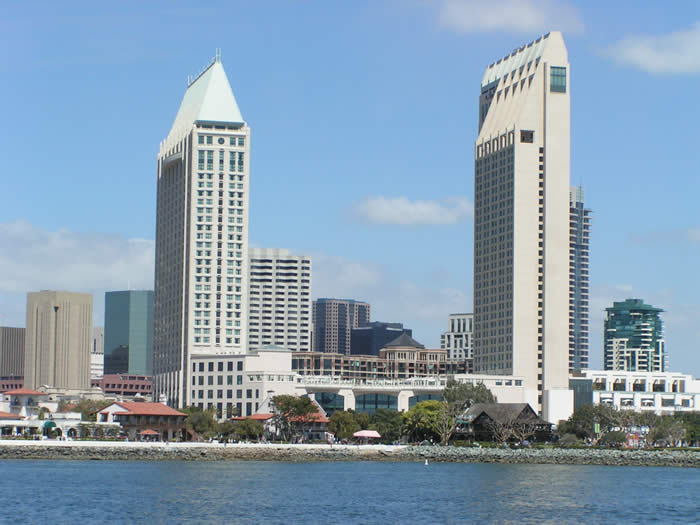
WHERE: Manchester Grand Hyatt 1 Market Place San Diego, CA 92101 Map
WHEN: Sunday, February 15, 2009 11:00 a.m. (Clinton is scheduled to speak at 12:30 p.m.)
BACKGROUND:
President Clinton is scheduled to give a paid speech this Sunday at the Manchester Hyatt in San Diego to the annual convention of the International Franchise Association. To give this speech, President Clinton will have to violate a union boycott and labor dispute -- the workers at the hotel lack job security and the housekeepers face onerous workloads.
But that's not all. President Clinton will also be offending supporters of marriage equality. Doug Manchester, the owner of the hotel, contributed $125,000 in early seed money to the Proposition 8 campaign.
"It is ironic that, by showing up at the Manchester Hyatt on Sunday, President Clinton will provide comfort to Ken Starr and the Prop 8 Legal Defense Fund, who are now trying to defend the constitutionality of Prop 8 before the state Supreme Court," said Rick Jacobs, upon learning Clinton intends to speak at the hotel on Sunday. "Doug Manchester's significant $125,000 contribution to the "Yes on 8" campaign helped pass Prop 8 -- money that made Starr's case possible."


 Posts
Posts